


In her long career as an addiction counselor and clinical social worker, Barbara Fornoff has heard plenty of stories. “Of course, I can’t tell those stories,” she said. Although her work has certainly underscored her belief in the importance of personal history, her interest is in a much broader range of storytelling, and it’s something she began to develop long ago, before she became a professional counselor.
At first it was the simple joy of speaking in public, an act that a significant percentage of the world’s people view as one of their worst fears. That was definitely not the case for the long-ago fifth-grader who took the stage in a St. Patrick’s Day play in Northern Virginia. “I found I just loved being on stage,” Fornoff said. As she grew up, she sought out ways to perform and, over the years, realized that real-life stories told by ordinary people were just as exciting to her as anything a dramatic playwright could deliver.
After many years of participating in organized storytelling, Fornoff founded Cville Stories, a fledgling troupe of beginning and veteran storytellers who have gathered at the Batesville Market for several months starting last fall. Her training in making people feel comfortable talking about themselves combined with her love of storytelling has inspired her to work with those who believe they have a story, but are not sure how to tell it.
There’s plenty of wildly divergent material in daily life, she said, but good stories have some things in common. “There has to be an arc,” she said, “a beginning, middle and an end, but something else has to happen. I want to see how the story changed the teller, and I want to see something that connects the story to human experiences we all understand.” There has to be something at stake, she said, in order for the audience to care.
In addition to helping people find the structure of their story, Fornoff coaches people on how to engage with an audience, and what is most likely to work on stage. Live story telling is very different from reading a script, and storytelling at Cville Stories events is done from memory. Fornoff said she often works with writers to translate stories they’ve already told in their written work into a dynamic, more conversational delivery. Coaching is part of the process, she said. “I hear every story before I include it, and we work to make it as good as it can be.” This also makes sure there’s a variety of tone and points of view, and that the subject is true to the theme of the session.
In her long history with storytelling events, Fornoff said she’s seen a few disasters. There was one teller who completely froze, and another who lost the thread and failed to follow the cue of the moderator who took the stage to try to end the uncomfortable, rambling tale. Another pitfall for an event that’s completely unrehearsed is the tendency of some tellers to mistake a rant for a story. In her coaching, Fornoff is committed to making sure the people she works with have confidence in their story before they present it.
Fornoff lives in North Garden, and besides still working part-time in her profession, is a hand weaver. Her reason for landing in western Albemarle towards the end of her formal career also says something about her unshakeable belief in the importance of community. “My brother lives near here,” she said, “and his idea was that his three siblings should all be close by.” Community is also the reason she began Cville Stories, and why she quickly recognized the importance of the Batesville Market, where the story-telling is set.
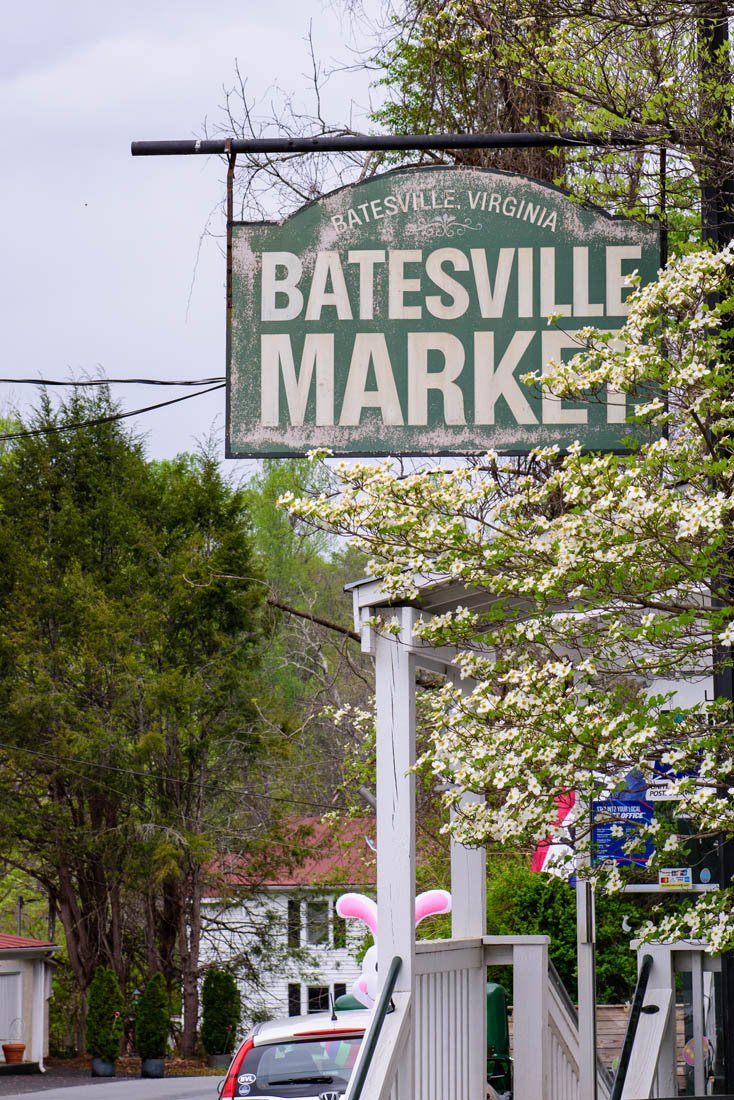 Batesville immediately felt like home to Barbara Fornoff. Photo: Malcolm Andrews
“I walked in there and immediately felt what I now know as ‘the Batesville vibe,’” she said. “It’s a community center, a place where everyone is welcome and feels comfortable. That tradition has continued with Kristen (Kristen Rabourdin, the market’s owner).” To honor that vibe, Cville Stories welcomes tales that are irreverent or offbeat, but not cruel, insulting, or laced with profanity.
Despite her own comfort with an open stage, Fornoff understands that some stories involve the teller recalling an event that may have been truly traumatic at the time it occurred. Her training comes in handy under those circumstances. The trauma can sometimes be reduced in the telling, and telling stories has served this purpose, along with the purpose of providing entertainment, since the beginning of humankind, she said. “It’s our oldest art form.”
Cville Story’s next show is Sunday June 29, from 4 to 6 p.m. at The Batesville Market. The theme for that show is “Back to the Garden” and Fornoff invites stories about the outdoors and about time spent in Mother Nature. Those who would like to pitch a story of 8-10 minutes with that theme can reach Fornoff through her website, cvillestories.com, or call her at 434-218-0881.


I am interested in Storytelling exploration on 4/18.