


The Albemarle County School Board voted unanimously on July 16 to adopt an updated grading policy after hearing protests from teachers, students, and parents earlier this year when the policy came up for review at the school division. Albemarle County Public Schools (ACPS) staff originally proposed in March that the division continue its current grading policy for another five years without changes, to which teachers immediately objected.
“I’m deeply troubled that there was no communication with stakeholders regarding this proposal and no data gathered or presented to the board regarding student outcomes or guideline implementation,” said science teacher Malinda Smith at the March board meeting. “Personally, I think that while the policy itself is well intentioned, the guidelines set forth in the grading handbook actually contradict the policy and lead to significant issues with regards to student outcomes.”
While the policy itself is a short, broad prescription for accurate and consistent grading, the existing regulations guiding the day-to-day grading of tests and assignments were flagged as significantly decreasing student motivation, preparedness, and effort, and frustrating and exhausting for parents and teachers. ACPS staff have since reworded and added specifics to the division’s existing ill-defined regulations, though they describe the work as a long-term project.
 ACPS Executive Director of Curriculum, Assessment and Instruction Craig Dommer Photo submittedCraig Dommer, Executive Director of Curriculum, Assessment and Instruction for ACPS. Submitted photo.
Executive Director of Curriculum, Assessment and Instruction Craig Dommer presented a set of changes in July that he called a “first step” rather than a full overhaul of the regulations. “We really wanted to focus [over the next year or two] on changes that would increase communication and reflect community feedback … but at the same time, we recognize there are some pain points [now],” said Dommer at the meeting.
Albemarle an Outlier
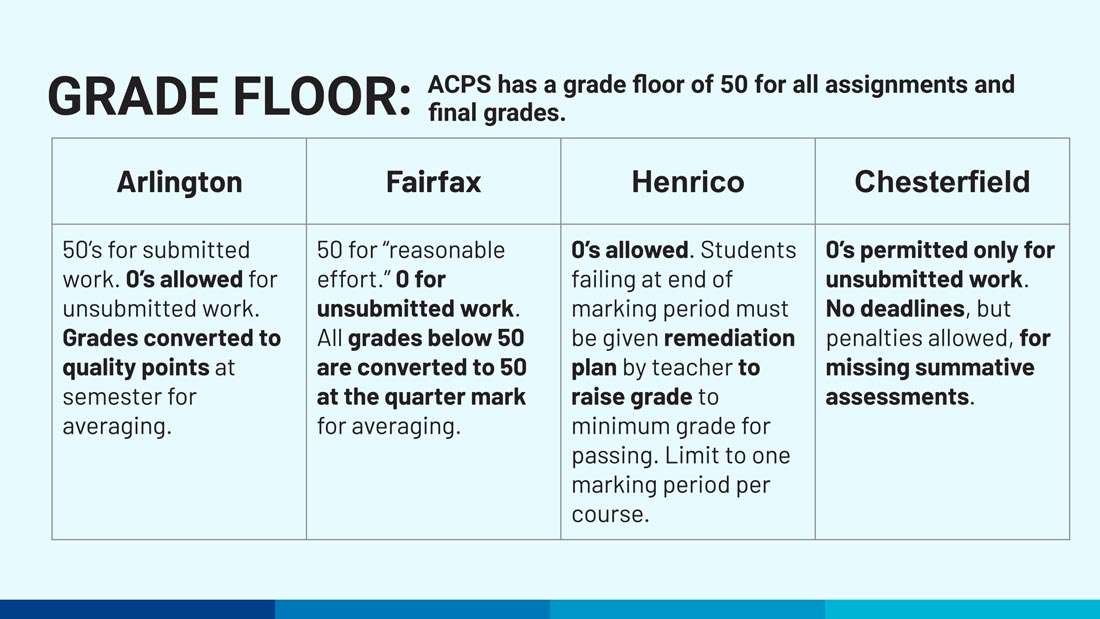
Over the last few months, the division’s Educational Equity Data Scientist Russell Carlock consulted with secondary school administrators and teachers, conducted focus group discussions with parents and students, and performed statistical analyses on student grades and test scores under the current grading system. When comparing Albemarle’s grading guidelines to those of other counties in Virginia and the U.S., Carlock found that ACPS is a significant “outlier” in virtually every aspect of its practices, and that since 2020 it has adopted and retained more extreme rules than most of its peers (see nearby slides).
In its update, the division suggested marginal changes to several aspects of the guidelines:
Beginning this fall, teachers will be required to notify parents if a student is at risk of failing a class or if a student’s grade drops by two or more letter grades by the six-week mark of any quarter, and semester grades will each count for 50% of a student’s final grade. Teachers will now be required to enter at least five grades per quarter, and no single assignment will be allowed to count for more than 30–35% of a quarter’s grade.
Students may retake or revise each graded assessment one time, and only if their initial score is below 90 (and their retake score cannot exceed 90), with practice work required first. (Last year, retakes were allowed upon student request up to the end of the semester with no practice requirement.)
Late work shall be accepted without penalty for the longer of two weeks or three class meetings from the due date. Following that time period, any late work may only receive a maximum grade of 85.
The grading floor will be a single F-band of 40-59. This means that the lowest grade that can be given is a 40% (down from 50% currently) even if no work is turned in. All submitted work that is “reasonably complete” will receive a grade of 50% or higher.
Debate
Rio District board member Jim Dillenbeck, who said he’s had extensive interactions with constituents on these rules, pushed back strongly on the grade floor. “One thing that was pretty much unanimous among all of the teachers and parents that I’ve heard from is that giving a 40 for no work turned in is completely unacceptable,” he said. “We’re saying we’re giving a student 40% credit for doing none of the work. Nowhere do we see that happen in the real world, and we should give a zero when a student doesn’t turn in work. [With the 40% floor] they calculate how much they can get away with and still pass, and we don’t want to perpetuate that. It needs to stop.”
Dillenbeck also addressed the late work policy. “I take issue with this policy of work that’s turned in up to two weeks late has no penalty,” he said. “Again, where in the real world does that happen? I think we need to we need to begin teaching young people there are consequences for the work habits that that they’re building. UVA discounts the grade point averages of Albemarle County students—I can attest to that—because they know our grading system is skewed, and that hurts. That is hurting our students.”
 Jim Dillenbeck, Rio district Albemarle County School Board member. Photo: ACPS.
Board members Allison Spillman [At-large] and Judy Le [Rivanna], both of whom have students in ACPS, said they have felt the implications of the grading guidelines acutely. They lamented that the online grade book doesn’t accurately reflect whether work has not been turned in yet or simply has not been graded, but had to admit that teachers are unable to enter grades into the grade book until the student’s extended period for turning in work has been exhausted.
Regarding assessment retakes, board chair Rebecca Berlin [White Hall] pointed out that there is still no limit on how long students have to complete the retake. “From the perspective of teachers who wind up spending a lot of time on retakes, particularly those that are significantly delayed from the time that the test is taken, I’m wondering is there a reason we’re not putting a time limit on that?” she asked. “Particularly with a lot of math and science classes, students end up just waiting to retake and that affects teachers’ plan for [teaching and] grading.”
Dommer replied that all aspects of the retake guidelines—the timing, the limit on how many are allowed, and the numerical grade improvement limit (up to 90%)—are all still on the table. “We’re just kind of trying to land on what is enough change to give some relief to teachers, and what would be too much [at one time],” he said, and added that a grading committee will be established that will review and refine grading practices, incorporate feedback from teachers, use results from “early-adopter pilots,” and help steer ongoing, iterative changes to the grading policy.
Spillman questioned Dommer about the unhurried timetable for policy changes. “So, again, this is an ever-evolving process, I’m guessing?” she said. “You know, we’ve had this grading policy for a number of years, and not much has changed in it. I’m hopeful, at least, that we’ll be taking what we’re learning on all sides and adjusting it as necessary over the next [period of time].”
“I think it’s something we’ll get feedback from the committee on,” said Dommer. “I think just as a kind of starting point, at least in my head and I think people that I’ve been talking to and thinking about this [agree] there will probably be a large update to regulations next year, and then it might be more like they’ll continue to meet and take feedback and look at evidence, and then maybe make changes every two years or so.”
For families and teachers, the revised grading handbook will be updated and sent home before the first day of school, new teachers will be briefed at the New Teacher Academy, and all staff will review the changes during pre-service week, with an optional Q&A session open to any teacher with questions.
 ACPS provides substantially lower levels of grading guidance and specificity to its teachers and staff than do most other school divisions. Image: Albemarle County.

