


As the Earth tilts towards the autumn equinox on the 22nd —when day and night are of equal length – it is only fitting to take stock of the summer garden. Here in the hollow, as throughout the state, it has been a stressful season, marked by the effects of years-long drought followed by subsequent fearsome afternoon storms that have allowed Albemarle and Nelson counties to come within spitting distance of erasing our rain deficit for the year.
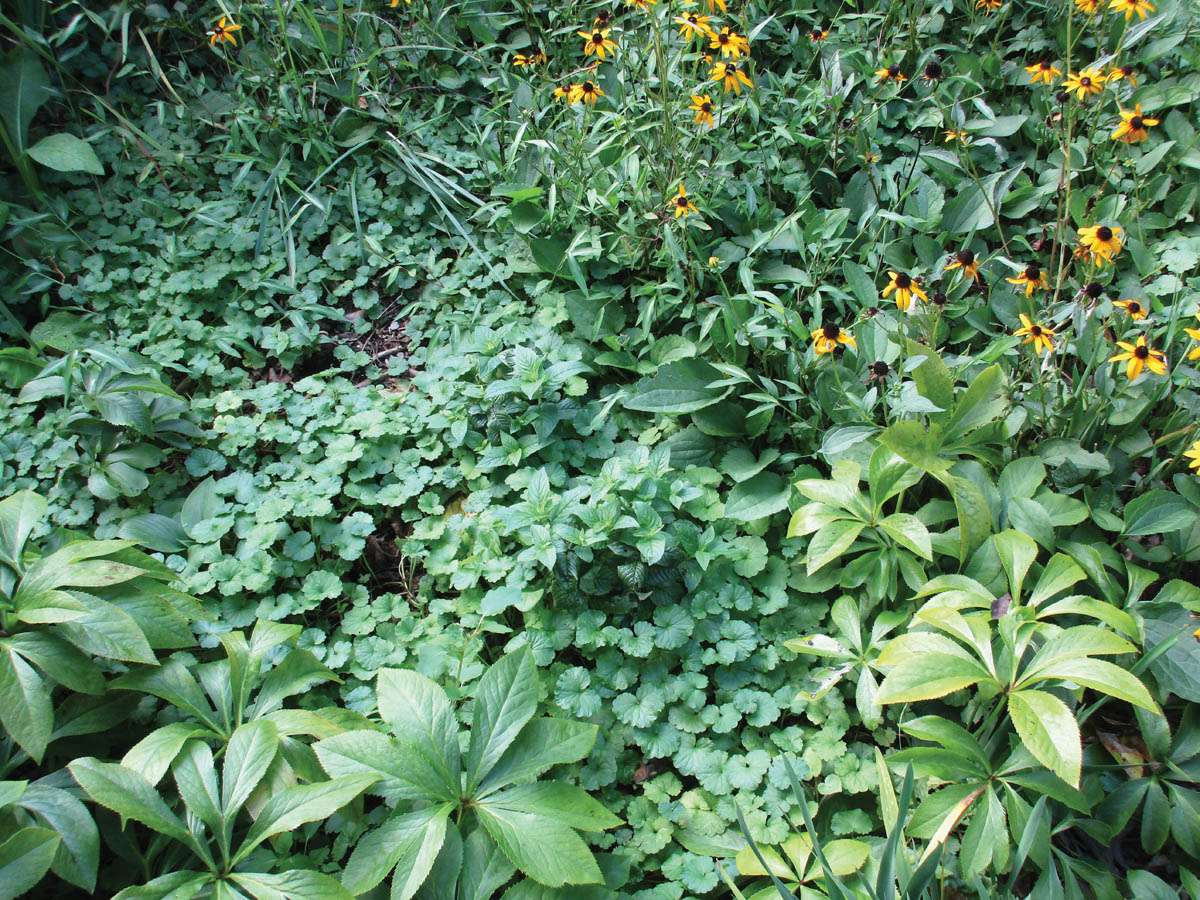
I gave up spot spraying after the rains came and the deer now run rampant. All that’s left is what they have not eaten (so far): Hellebore (Lenten Rose), fern, ground ivy (see below), Ageratum, Cleome, marigolds, zinnias, Rudbeckia, river oats (Chasmanthium latifolium), spider flower (Lycorus radiata), rosemary, mint. The only real deterrent for us out here in the country is a fence.
Once the pride of the porch border, the jewelweed (Impatiens capsicum), a re-seeding native annual, is grazed to the ground. They cannot resist its lush leaves, a paste of which is said to be a natural balm for poison ivy. Peony foliage as well as the poisonous monkshood (Aconitum) have been stripped, the fig bush decimated, hostas devoured.
Assailed on all sides, I experience the gardener’s Sisyphus-like despair of trying to beat back both the flora and the fauna. Chinese stilt grass (Microstegium vimineum), apparently unpalatable to the voracious ungulates, threatens to overtake parts of the flower beds. This oppressive import, originally used as packing material, now carpets much of the woodland edge along the state road as well as the banks of our creek. Patches of native Christmas (Polystichum acrostichoides) and woodland (Dryopteris sp.) fern persist but their habitat is decreasing. I have not seen the cardinal flower (Lobelia cardinalis) which used to appear along the creek and fear it has been crowded out. 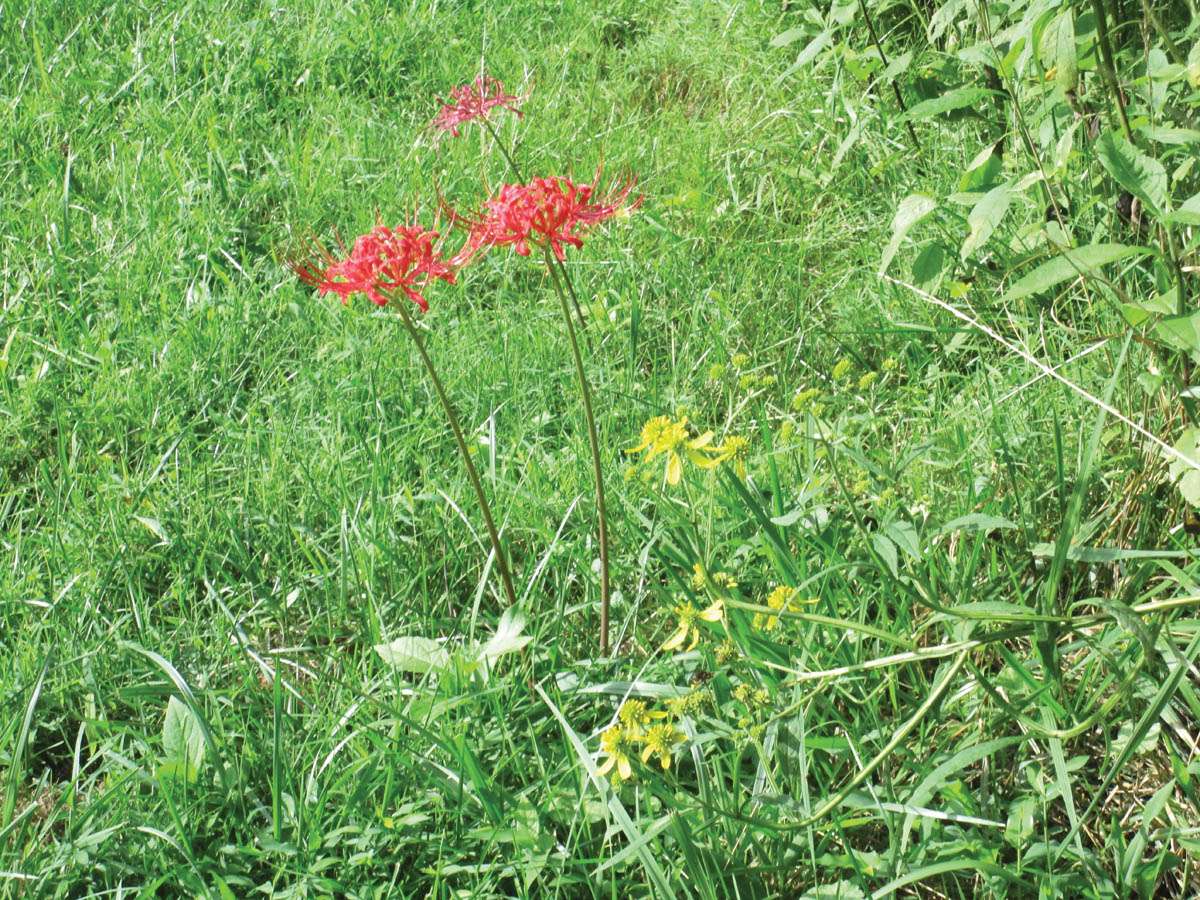 Spider flower and wing stem. Photo by Cathy Clary.
Still, we must make our stand somewhere and I am resolved to keep the porch borders weeded before anything goes to seed and continue establishing groundcovers that give no purchase to the invader. I had great hopes for dwarf plumbago (Ceratostigma plumbaginoides), a lovely late blooming, blue-flowered perennial that makes a fine planting under trees as well as being able to hold down a curbside bed, but it simply straggles along in my border. It’s better on its own rather than in a mix with other perennials. I recite the gardener’s prayer and resolve to do better next year.

Likewise, the golden creeping Sedum ‘Angelina’ straggles in too much shade from taller plants. Aside from the Nepeta ‘Walker’s Low’ which rebounded nicely after a mid-summer haircut, the most successful at covering ground has been the humble aptly named ground ivy (Glechoma hederacea). A European-introduced perennial, mine appeared on its own (I imagine it escaped into the wild long ago), but Sandy’s Plants down in Mechanicsville used to offer it. It does well in sun or shade and forms tight mats.
My summer flower borders were the ugliest in history, dependent as they were on commercial varieties like Zinnia ‘Profusion’ which for some reason displaced the graceful airy ‘Star White’ I used to rely on. The elegant multi-branched straight species Cleome spinosa is not to be found (though I did have a few welcome re-seeds of the pure white ‘Snow Queen’), only stumpy ‘Arana Violeta’ bred for its longer stamens. Never again will they deface my garden. The old-fashioned cultivars that I love “are not marketable in the pot” and I will have to grow them from seed myself next year and quit whining.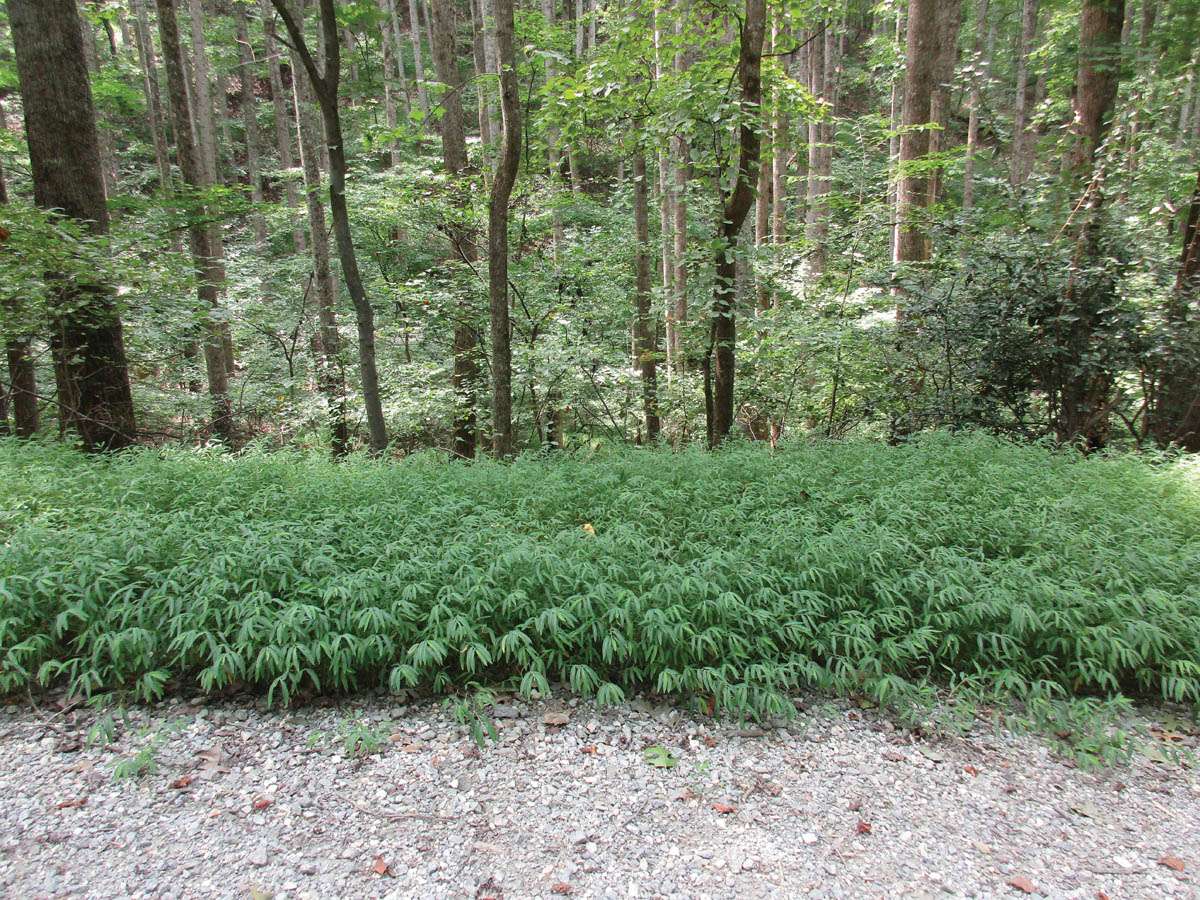 Chinese stilt grass. Photo by Cathy Clary.
On the positive side, blackberry lilies (Belamcanda chinensis) made a striking orange edge to the blue Vitex in the field and a transplanted ironweed (Vernonia noveboracensis), a gift from a friend (the most lasting memorial in a garden), has established well in the meadow. I hope it will spread and complement the swathes of chrome-yellow wingstem (Verbesina alternifolia), also called yellow ironweed, that predominate throughout our fields and meadow.
The native honeysuckle Lonicera sempervirens with its pink-orange trumpets has attracted a faithful hummingbird and is slowly climbing the lattice of the potting shed. Rosemarys thrive against the south wall with excellent drainage. A native virgin’s bower (Clematis virginiana) has climbed the Meyer’s Pink Viburnum and exploded into white lace on top, drawing swallowtails and bees.
When exactly was it that we began to fear the weather? Some are still cutting their way out of the damage of the August wind and hail storms. Despite our tentative reprieve from the drought, these all too predictable extremes of weather are worrisome not only for us here in central Virginia but all over the planet. It’s hard to close our eyes to it. But do what we will to her, the world keeps spinning. The way things are going, we better hold on tight.


