


The recent denial of a rezoning application for a proposed mobile home park in southern Albemarle revealed a split in the attitudes of the Board of Supervisors about how and when to allow new development in the county’s rural areas. The schism could have implications not only for Crozet’s two mobile home communities, but also for the future of the county’s designated development areas, of which Crozet is one.
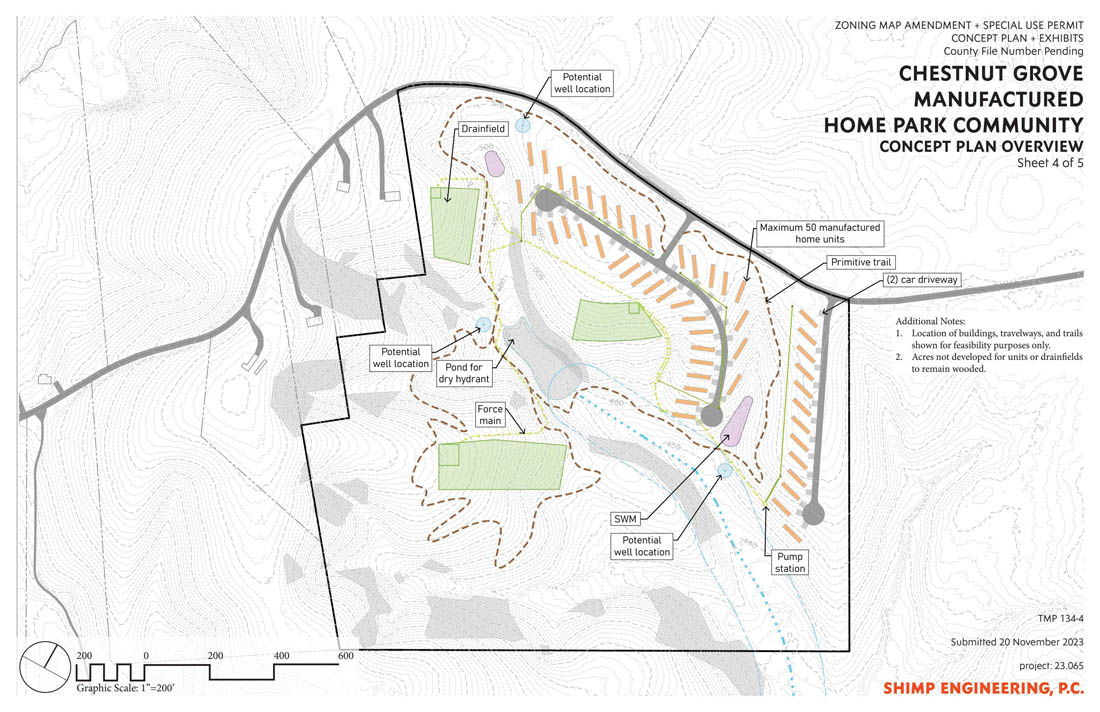
Justin Shimp, of Shimp Engineering, proposed a rezoning and special use permit for a 50-acre, 50-unit manufactured (mobile) home park called Chestnut Grove to be built in the rural area in southern Albemarle near Esmont. Shimp, both an investor and engineer on the project, requested a rezoning from Rural Areas to R-4 (4 units/acre) for the park at the board’s March 5 meeting, stressing the strong need for affordable housing to accommodate growth projections in Albemarle.
In his initial remarks, Shimp cited a 2019 housing study that said, over the past two decades, “housing prices have increased rapidly as new construction failed to keep pace with the increased demand at all but the highest rent and price levels.” The study also noted that the county’s development areas—where new housing is intended to be built—have shrunk from 48,000 to 23,800 acres since 1971.
In a mobile home park, residents typically own their manufactured home (or have a mortgage on it) and lease the lot on which it sits, also paying for utilities and fees such as water and sewer, electricity, and trash service. Shimp demonstrated that the much lower cost of rent in a park as compared to living in an apartment complex—even when also making mortgage payments—means the mobile home park tenant pays about $7,000 per year less than the apartment dweller.
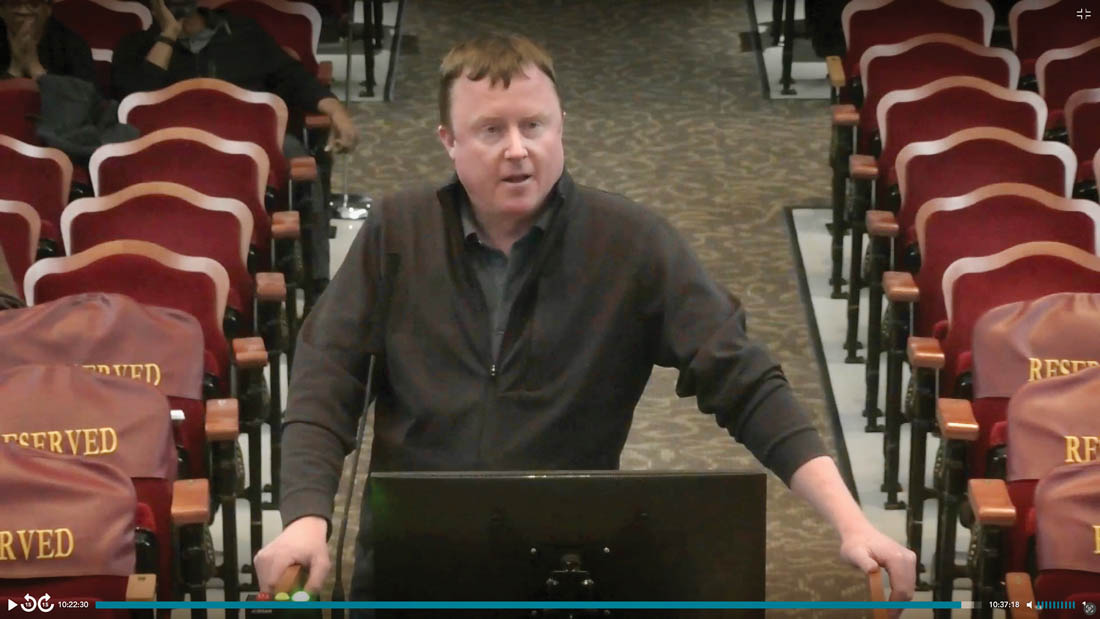 Justin Shimp
Per county rules, if Shimp were to develop his site without a rezoning approval, he could build “by right” only six homes on the property. “Why is this [manufactured home plan] different?” Shimp asked. “If we developed this land by right, we would clear-cut the land and build six large houses on it. That’s a similar impact on the land in terms of clearing it, but it’s a very different outcome for the 50 families who don’t get to live there, because they’re not going to be able to afford those 5,000-square-foot houses.”
A Clash of Views
Ahead of the meeting, county planning staff recommended denial of the application, on the grounds that the plain language of the county’s own Comprehensive Plan guides its zoning ordinance that rural area residential development be no more than one dwelling unit on a minimum of two acres of land. Because of the Chestnut Grove site’s critical slopes, stream buffer requirements, and other unbuildable areas, the 50 manufactured home spaces would be situated on approximately one-quarter of the 50-acre parcel. (Albemarle’s “gross density” rules allow this plan to count as a one unit per acre project—still too dense to be built without a rezoning.)
“The [county’s] Growth Management Policy promotes residential development in the Development Areas where infrastructure and services are available, to avoid conflicts with Rural Area land uses [such as agriculture, forestry, and conservation],” read the staff report. The report added that there are inadequate services, facilities, and infrastructure to support the development. Albemarle’s designated rural areas comprise 95% of its total land area.
More than 25 people spoke during the public comment section of the meeting, a majority of whom supported the project for increasing affordable housing for working-class residents. The remainder expressed concerns about traffic, water supply, transportation, emergency service availability, and the suitability of the site for dense development.
Rolf Braun of White Hall suggested the board address a more fundamental issue. “I think the question the county needs to ask is not, ‘if we approve this, how many others are going be submitted like it,’ [but rather] ‘if you don’t approve this, what can be approved?’” said Braun. “The developer said—and this was unchallenged—that you couldn’t build [this project] according to the Comprehensive Plan anywhere in the county, and not only that, you couldn’t do unsubsidized affordable housing anywhere in the county. That’s a pretty bad situation to be in. If that’s the case, the Comprehensive Plan is not worth the paper it’s printed on.”
During the board’s discussion, three supervisors said they would not support the application. Chair Jim Andrews said that approving this project was not the right direction for the board. “Our mode of operation is that the Comprehensive Plan leads the rezoning. Yes, there’s a tremendous need for affordable housing, but I’d rather have us talk about these issues [in some] coherent way with staff before we approve a project that isn’t really consistent with what we’ve planned to do. I can’t be supportive of this application—it just feels too ad hoc.”
 Ann Mallek, White Hall Board of Supervisors representative.
White Hall District representative Ann Mallek was concerned about the “predatory” nature of land leases. “This is not a slam dunk that it’s a benefit for the residents,” she said. “Because of the cost of the unit, plus the almost as much cost to put it in place, you can’t necessarily remove it and go to some other place. And all the time the equity is not coming to the person who owns the unit. I think it creates a situation that is putting vulnerable people in a really big trap.”
Bea LaPisto-Kirtley said the project was “a good idea, but a bad location.” “We as a board have said we’re not going to increase the development area,” she said. “I do believe that we need more affordable housing, [but] we have to make sure where we’re putting it. We need to go higher and denser in the development area to provide for affordable housing.”
For the other three supervisors, however, the goal of adding affordable housing stock outweighed adherence to the zoning ordinance’s rural area building restrictions. Supervisor Mike Pruitt said this was the hardest vote he’d encountered on the board. “It is abundantly clear that we have not adequately contemplated mobile home parks in the Comprehensive Plan and in our own zoning code,” he said. “Historically, we have treated up-zoning in the rural area for residential purposes as a bright line that this board recognizes, and we would be crossing a Rubicon if we approved. We have not created a framework to allow rural mobile home parks, full stop.”
 Mike Pruitt, Scottsville Board of Supervisors representative.
Rubicon notwithstanding, Pruitt made the case for approving the rezoning as he listed numerous Scottsville businesses that have recently closed due to a lack of working-class residents to patronize those places. “Scottsville needs people, it needs a sustainment population, and frankly the public comment I heard today was incredibly persuasive,” he said. “Those folks want amenities and they want somewhere to live, and we don’t normally hear from them—it’s usually the people in the $1.3 million houses we hear from. I don’t like it. I’m going to be supportive of the project.”
Diantha McKeel said, “I probably won’t be able to sleep tonight if we deny this, because of the folks we heard from who desperately need a place to live, and I’m willing to give Justin [Shimp] a chance at this. We have been doing the same thing for the last 12 years and the affordable housing situation has gotten worse and worse, and I’m ready to do something different.”
Ned Gallaway rounded out the discussion by stating that Chestnut Grove was a type of rural development that is “acceptable” to him. “If we don’t figure out a way that the rural area can help solve affordable housing, then we’re not going to be able to move the needle [on that problem],” he said. “We can’t allow fifty units in the development area—it’s not dense enough.”
None of the supervisors in support of the project suggested incorporating this more expansive view of rural area development into the Comprehensive Plan before voting for the rezoning, nor did they urge the board to change the county’s Growth Management Policy. Per board rules, the 3-3 tie vote meant that the proposal was not approved. Shimp, who provides engineering services for the majority of development projects that come before the board, made a brief closing statement describing the logjam as he sees it.
“I want to make really clear, you cannot build this project in the development area,” said Shimp, explaining that only in the rural areas is land inexpensive enough to build small houses on. “There’s no economic incentive or possibility of it happening because of its [low] density. The only way you can justify the price of land in the development area is with density—30 or 40 units per acre, not one unit per acre. I cannot build somebody an affordable house that they can buy or rent on a 6,000 square foot lot in the development area. It cannot be done.”
Shimp asked the board to perhaps reconsider its decision in the future. “I wish the board would have given this a chance,” he said. “I see no way to achieve what you’re trying to achieve [affordable housing] without this kind of project, and I simply can’t build this anywhere else.”
Supervisor Mallek’s View
The Crozet mobile home community of Beaver Hill on Rt. 240 may face the same headwinds when attempting to expand their operation into the adjacent rural area, as they applied to do in October of last year. Though Beaver Hill is not a new project, the intended property would have to be up-zoned from Rural Areas to R4 to be able to add new tracts for additional manufactured homes.
Supervisor Mallek shared her thoughts with the Gazette after the Chestnut Grove hearing, calling the question of development in the rural area “a tangled web of issues.” “The Comprehensive Plan is a guideline and the basis for the adopted zoning ordinance, which are the RULES,” she said. “The ordinance is the backbone for the recommendations from staff [on these applications]. The Comp Plan should be changed before the ordinance is changed, and before votes are made in favor of an application because the idea sounds nice.”
Mallek said the best decisions are ones made based on the ordinances, in order for them to be upheld in court and to be fair to present and future applicants and residents. “In hindsight,” she said, “the question that should have been asked by the board to itself was: IF this application had nothing to do with manufactured or affordable housing, would the board rezone this property to have 50 units on a very few acres and without any public services such as public road, water or sewer? I would have voted no, because it is against the Comp Plans I have lived under since I returned to the farm in 1982.”
In answer to whether she thinks the board should add allowances for mobile home parks in the rural area to the Comp Plan being updated right now, Mallek said her highest priority is maintaining the naturally occurring affordable housing (NOAH) the county has now. “Reactivating the assessment of the NOAHs in Crozet is essential to consider an overlay, or footprint max, something to prevent neighborhood loss.”
“Second, the quality of life for people living in lower-cost housing, manufactured home parks, tiny houses, or apartments and town houses should not be negotiable,” she said, adding she does not support removing shade trees, grass, adequate parking, or proper recreation so applicants can “cram more units into a confined space for their affordability bonus.
“The reasons for larger lots in the rural area are because each lot must be self-sufficient, with its own well and septic. There has to be distance—that cannot happen when 50 units are put onto a very few useable acres.”

