


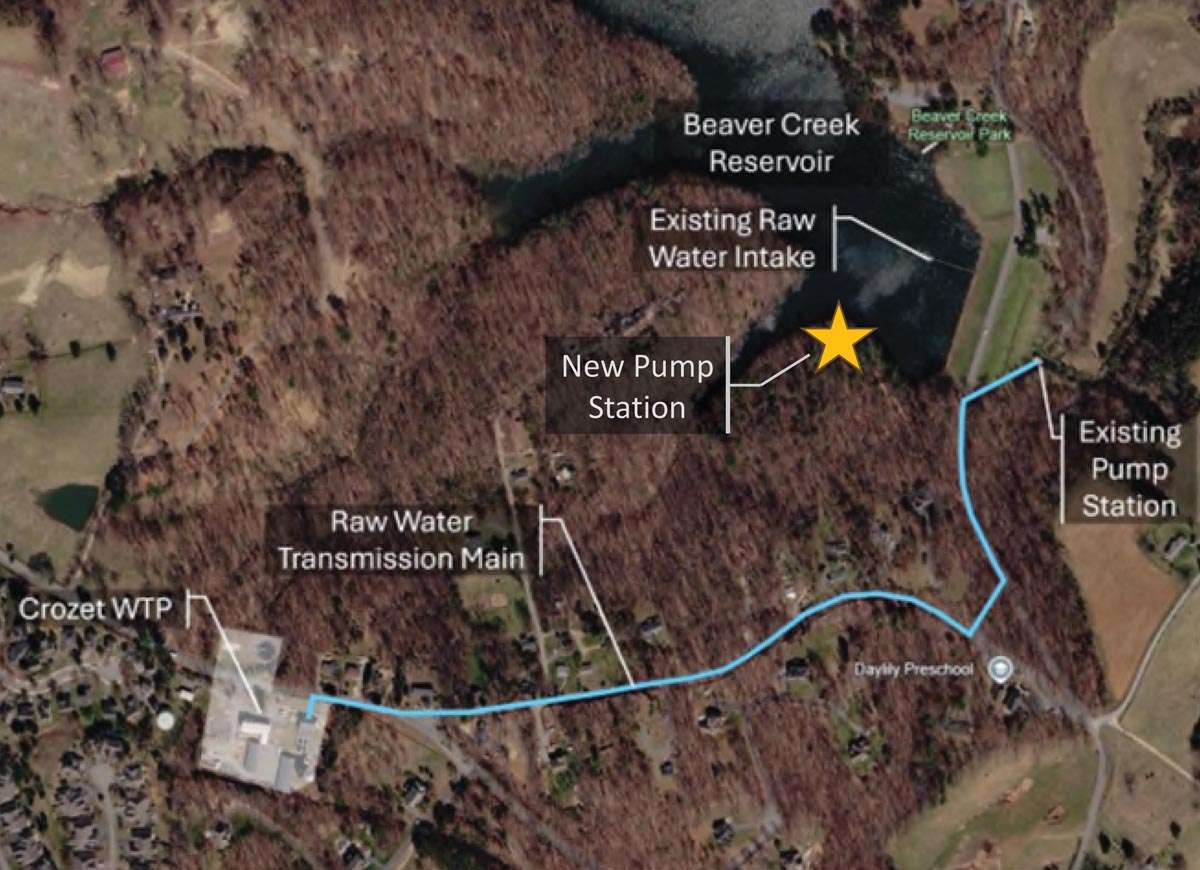
The Rivanna Water and Sewer Authority (RWSA) received approval of a special use permit from the Albemarle County Board of Supervisors on September 16, in one of the agency’s final steps toward building a new raw water pump station at the Beaver Creek Reservoir. The $39 million pump station relocation will be followed by the replacement of the Beaver Creek Dam itself, with both projects to be completed by 2031. The reservoir is the sole water supply for the Crozet community.
The reservoir’s pump station pulls raw (untreated) water from the reservoir and pushes it through about three-quarters of a mile of piping to the treatment plant on Rt. 240. The old pump station currently sits on land below the dam structure on its east side, while the new one will be sited on a small piece of county-owned land jutting out just above the dam’s west (upstream) side. Site constraints require two retaining walls so that the facility can be constructed on a steep grade, and the RWSA’s permit requested 450 cubic yards of fill in a small portion of the floodplain fringe and in the areas behind the walls. The RWSA said the fill will result in no rise within the 100-year floodplain of the reservoir, and extensive replanting is proposed around the new facility to maintain the forested character of the parcel.
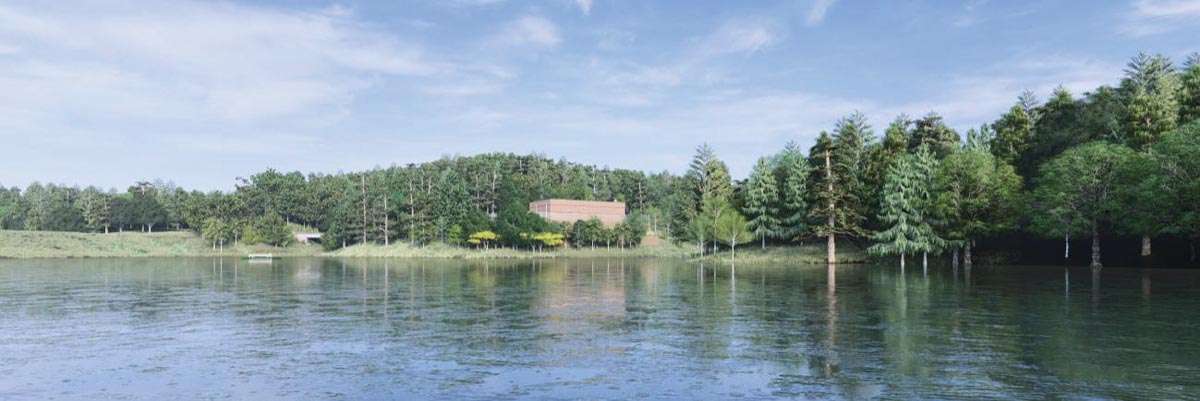 Rendering of the new pump station as it will look from across the Beaver Creek Reservoir once constructed and landscaped. Courtesy RWSA
“The pump station project will consist of a new building, a new access road with a bridge, and a tunneled intake out to an in-reservoir tower,” said Victoria Fort, the RWSA’s project manager on this project, “as well as a transmission main from the new station back to the treatment plant along a similar route as the existing one. With a maximum raw water pumping capacity of 2.8 million gallons per day, [the station] will be sized to meet the needs of the community through at least 2075.”
Fort also described a new “diffused air destratification system” included in the project. She explained that Beaver Creek Reservoir experiences thermal stratification during the spring-to-fall months where cooler water sinks to the bottom and retains very little oxygen. Nutrients and metals are released into the water there and when the outside air cools, they rise to the top and can cause algal blooms and degraded water quality.
“The diffused air system consists of air compressors which push air out into pipes along the lowest level of the reservoir, and the air bubbles effectively mix the full depth of the reservoir and improve the water quality overall,” said Fort. “So, you can expect to see air bubbles along straight lines from where the pipes are located when the project is complete.”
Dammed if you do
Much of the current activity surrounding the 60-foot-high Beaver Creek Dam, built in 1963, was set in motion by the state’s 2011 reclassification of it as a “high hazard” dam. This ranking does not mean the dam itself is hazardous, but that a dam failure would cause probable loss of human life or serious economic damage downstream. To reduce the risk of failure, a high-hazard dam spillway must be able to sustain a “probable maximum precipitation” event in which 24 hours of rainfall produces about 30 inches of rain. While that may seem like a near-impossible occurrence, Hurricane Camille dropped 27 to 31 inches of rain in an 8-hour window in 1969 in nearby Nelson County.
Older earth-fill and embankment dams like Beaver Creek are vulnerable to failure if water flows over the crest of the dam, which can cause rapid erosion that can lead to a sudden breach. A breach could cause inundation of people and structures downstream, and could also completely deplete the Beaver Creek Reservoir, causing catastrophic water shortages in Crozet.
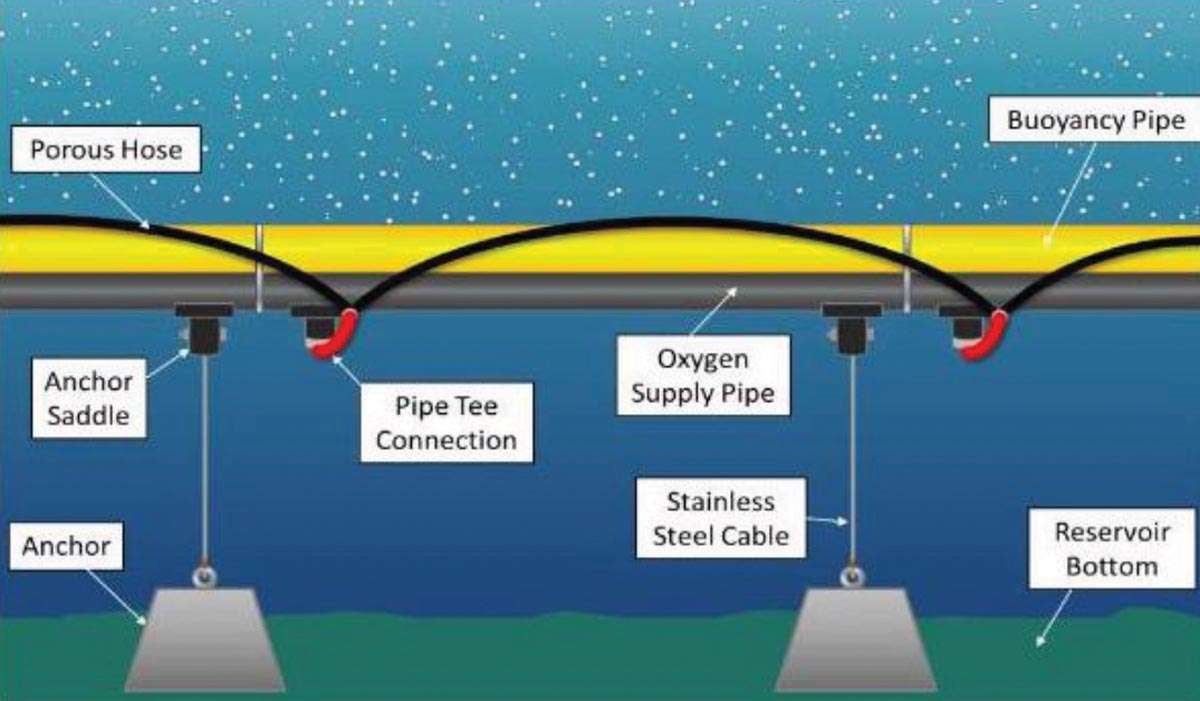 A diffused air destratification system will be installed along the bottom of the reservoir to improve water quality. Courtesy RWSA
To address needed upgrades to the dam and pump station, along with increased demand for drinking water in the Crozet community, the RWSA undertook the lengthy and arduous process of acquiring a Virginia Water Protection permit from the state Department of Environmental Quality (DEQ) to allow it to disturb a wetland or stream as it replaces the dam. With that permit now in hand, the RWSA plans to replace the old dam with a “labyrinth spillway system,” a zig-zag shaped wall that will dramatically increase water discharge capacity over the same span (width) of the current dam.
The water protection permit also allows the RWSA to address various required water flows. In recent years the DEQ has revised its estimates for how much water the reservoir must release downstream of the dam, called “instream flows,” which support fish populations, maintain water quality, and preserve stream bank habitats in parts of the river downstream of the dam. Instream flows can be better controlled with a pump station above the dam as Beaver Creek’s will be.
The current cost estimate for the pump station project with its associated infrastructure is $39.1 million, said Westley Kern, Communication and Outreach Coordinator for the RWSA. “We’re anticipating having the floodplain development permit, the site plan, and the WPO [water protection ordinance permit] done by the end of November,” said Kern, “and we have some water line easements that we’re working on because we do have to run a new pipeline from the new pump station all the way back to the Crozet water treatment plant.”
The pump station plan will not require traffic to be rerouted, but the dam replacement project will include rebuilding the road section of Browns Gap Turnpike that runs across the top. For that project, the RWSA’s current plan is to build a “cofferdam,” a temporary watertight space to hold the water back while work is ongoing, and to create a path along there so traffic can still go through during construction.
While the new pump station will be bigger and more conspicuously sited than the old one, the plans include heavy landscaping around the area once it’s put into service. “We’re hoping to get shovels in the ground in the spring and to complete the pump station by 2029,” said Kern. “Then hopefully by the end of 2031 the new dam will be in place.”

