


by Mary Lyons
Catch up on Part 1 of this Series
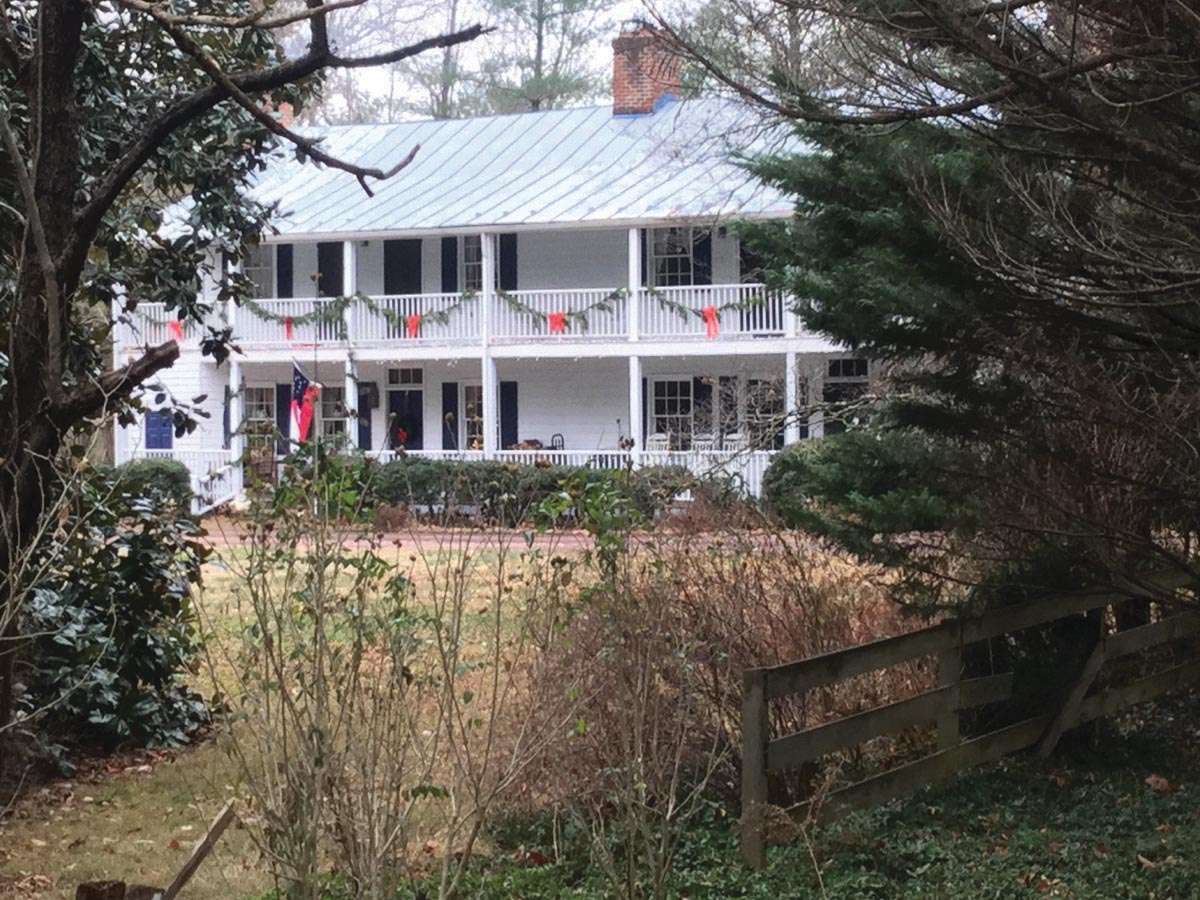
John S. Cocke (1799–1879) operated a tavern and inn in Greenwood, Virginia. Known as the Long House, it was located on what was then Rockfish Gap Turnpike and is now U. S. Route 250. Claudius Crozet wrote some of his letters with the return address of “Cocke’s” at the Long House, where the enumerator listed him on the U.S. 1850 census.
Cocke’s January 15th 1851
Quarterly report.
To the President and Directors
of the Board of Public works,
Gentlemen
The driving of the heading of the 2nd tunnel has been resumed: it has been necessarily suspended to secure the roof, which exposed to the air fell down in large masses to such a dangerous extent that the men had refused working on it.
Very respectfully Submitted
C. Crozet
Engn. Blue ridge r. road
The names of the two men crushed to death at Brooksville Tunnel are unknown. Contractor John Kelly kept his own payrolls from 1850 to 1854 and would have discarded them later. Albemarle County death records for the 1850s held at the Library of Virginia do not list deceased Irish laborers.
Engineer’s office, Richmond January 22nd ’51
Gentlemen,
The rock of the Second Tunnel turned out to be much worse than usual; and, moreover, was rapidly affected by the contact of the air. In consequence of this, I, very early, urged the contractor to secure by props the threatening rocks of the face, just over the entrance: notwithstanding my earnest and repeated solicitations it was neglected; and, as you have been informed, two men were crushed to death by the fall of the impending mass.
even after this sad casualty, the precaution urged was neglected; and, in the hearing of the President of the Board himself it was argued by the contractor, that it was idle to expect to sustain by props the whole mountain. At last, however, finding that the roof fell in and, in large masses, and that even the sides slid in, the men peremptorily refused to work in so dangerous a situation.
In conclusion, I do not think the timbering done so far in the second tunnel, about 140 feet for $350 objectionable, considering the circumstances of the case and that, on these steep slopes, where there is no road, the timbers had to be dragged by the hands working at the tunnel; and I would respectfully recommend the allowing of the account.
Very respectfully submitted
C. Crozet
Eng. Blue ridge r. road.
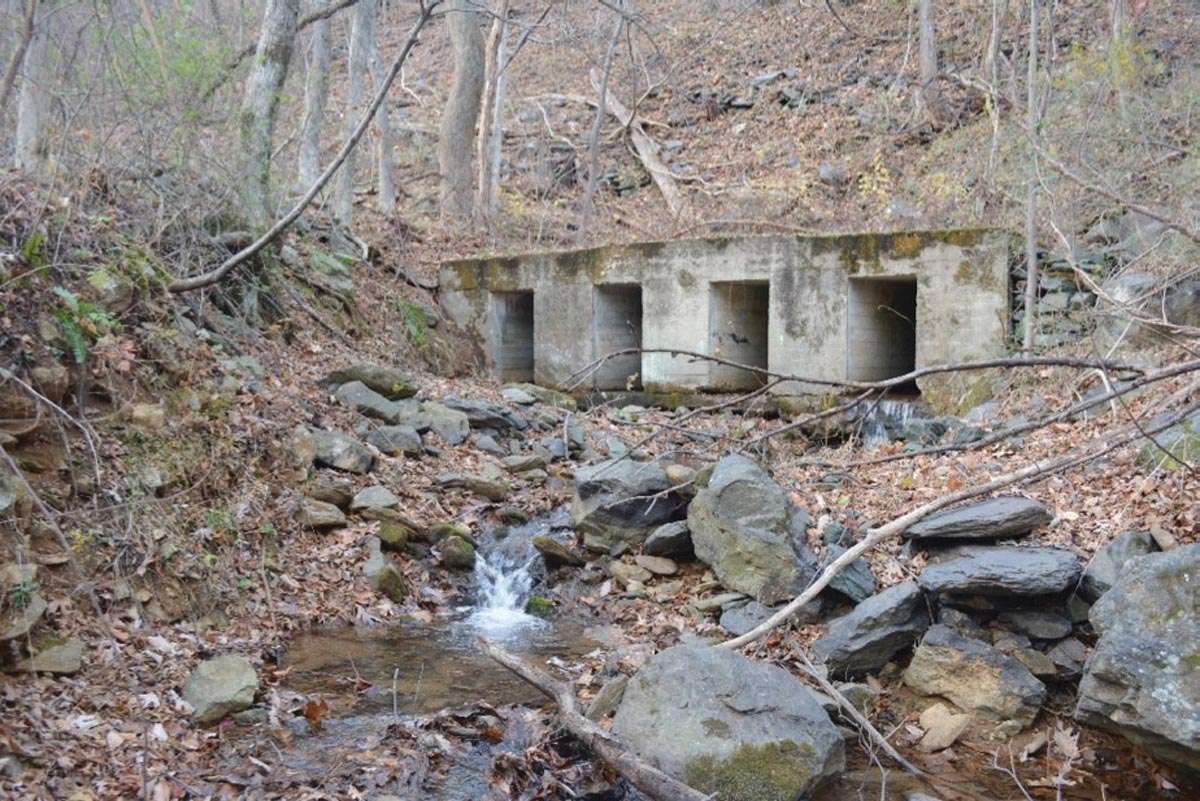 Man-made embankment and four culverts at Robertson’s Hollow. Photo: Author’s Collection
Crozet’s troubles continued when constant excavation of the soil weakened the roots of towering oaks on Bear Den Mountain’s northern slope. As the trees broke free of the earth’s grip, they hurtled to the ground near Brooksville Tunnel’s west entrance.
Engr’s office
Cocke’s April 5th 1851
Blue ridge railroad
Quarterly Report.
To the President & Directors
of the Board of Public works.
Gentlemen,
Smaller slides occur . . . and give to the work a ragged appearance: an excessively large one has also taken place just before the entrance of the Second Tunnel carrying down with it large oak trees: These unexpected slides will be a not inconsiderable addition to the cost of the work; I see no way to arrest them and account for them only by supposing that in wet weather a sheet of water is formed under the upper ledge and together with the disintegrating influence of the air causes them to break and separate slide on their inclined base.
On the 5th Section, the Second Tunnel is a very dangerous work and will prove very troublesome: the roof continues insecure and even the rocky sides slide in; and the excavation would soon be choked up without the support of timber frames. A road has been cut along the steep face of the hill to reach the entrances of the Tunnel and haul thereon brick & timber.
The contractor has offered a bid, now submitted to your honorable Board, for the construction of the arch, materials being furnished him, he agrees to build the arch for $5 per thousand, which I think reasonable considering the dangers to be protected from & the difficulties that will attend the construction. The Brick is to be furnished for $6 per M. [Roman numeral for 1,000] delivered; the proposal for it, is also herewith submitted.
The heading of this Tunnel has penetrated 252 feet.
Very respectfully submitted
C. Crozet Chf. Eng.
Blue ridge r. r.
Joseph Dettor (1807–1874) owned 400 acres between the Greenwood and Brooksville Tunnels in western Albemarle County. One of several brick makers for the Blue Ridge Railroad, his bricks for arching Greenwood Tunnel proved inferior.
Engineer’s office of the
Blue ridge r. r.
Cocke’s July 16th 1851
Quarterly report
To the President and Directors
of the Board of Public works.
Gentlemen,
On the 5th Section, the Second Tunnel had on the 1st of the month penetrated to a distance of 434 feet, leaving only about 300 feet to complete the perforation, which will probably be through before the eastern deep cut has reached it. I am sorry to add that the excavation instead of improving has become worse, and that the ground is so treacherous that an enormous amount of timbering has become indispensable; an idea of that necessity may be formed from the fact, that, in one instance, a perpendicular fall of the roof took place to such a height—that, with a long pole, at the end of which a lamp was raised, I could not yet see the top of the cavity thus formed; the men had at first refused to work there any longer, but returned ultimately and have made good progress since.
A brick arch being evidently indispensable, I have entered into a contract with Mr. Joseph Dettor for the furnishing of the requisite amount of bricks; I thought, since Mr. Kelly had no bid for this material that it would be expedient for the Board to furnish it. there will be no more certainty of its being such as we may desire. The contract has been laid before your honorable Board.
I have the honor to be, Gentlemen,
Your most obedt servt
C. Crozet Engr.
Blue ridge r. road
Most of the Irish workers on the Blue Ridge Railroad were Catholic. The Church required Mass attendance, if possible, on feast days known as Holy Days of Obligation. Extant Blue Ridge Tunnel payrolls for the years 1852–1857 show that few or no men worked on Christmas Day (Feast of the Nativity), the day after Christmas, January 1 (Feast of the Circumcision), and January 6 (Feast of the Epiphany).
Hiring season for enslaved labor in the antebellum South began shortly after Christmas Day. It continued for several weeks in the New Year. This was a time of flux during which hiring agreements for the previous year might be renewed. Or, a slaveholder could switch a hired slave to another hiring slaveholder, depending on the price offered for the labor.
Engrs. Office of the Blue ridge railroad
January 14th 1852.
Quarterly Report
To the Board of Public works
Gentlemen,
The construction of the track of the railroad of each side of the mountain . . . has been considerably checked by the holy days & hiring season, and also by the unusually inclement weather and great accumulation of snow along the face of the mountain.
This circumstance is not without its advantages; it was very desirable, before the road went into operation, that the slopes of the cuts and stability of the embankment should be fully tested: This soil is so treacherous, and slides are so considerable, that I was apprehensive of serious damage at the breaking up of the frost and the melting of snows, after the first hard winter; and it was desirable that this should take place rather before than after the [rail]road is in use, when it might be attended with greater expense and serious accidents.
Except [for] the 2nd Tunnel and Robertson’s hollow the whole road will be completed this year with a sufficiency of funds . . .
Very respectfully submitted,
C. Crozet
This series will continue with Part 3 in the December issue of the Crozet Gazette.

